How Much Money Should You Exchange Before Arriving in Korea?
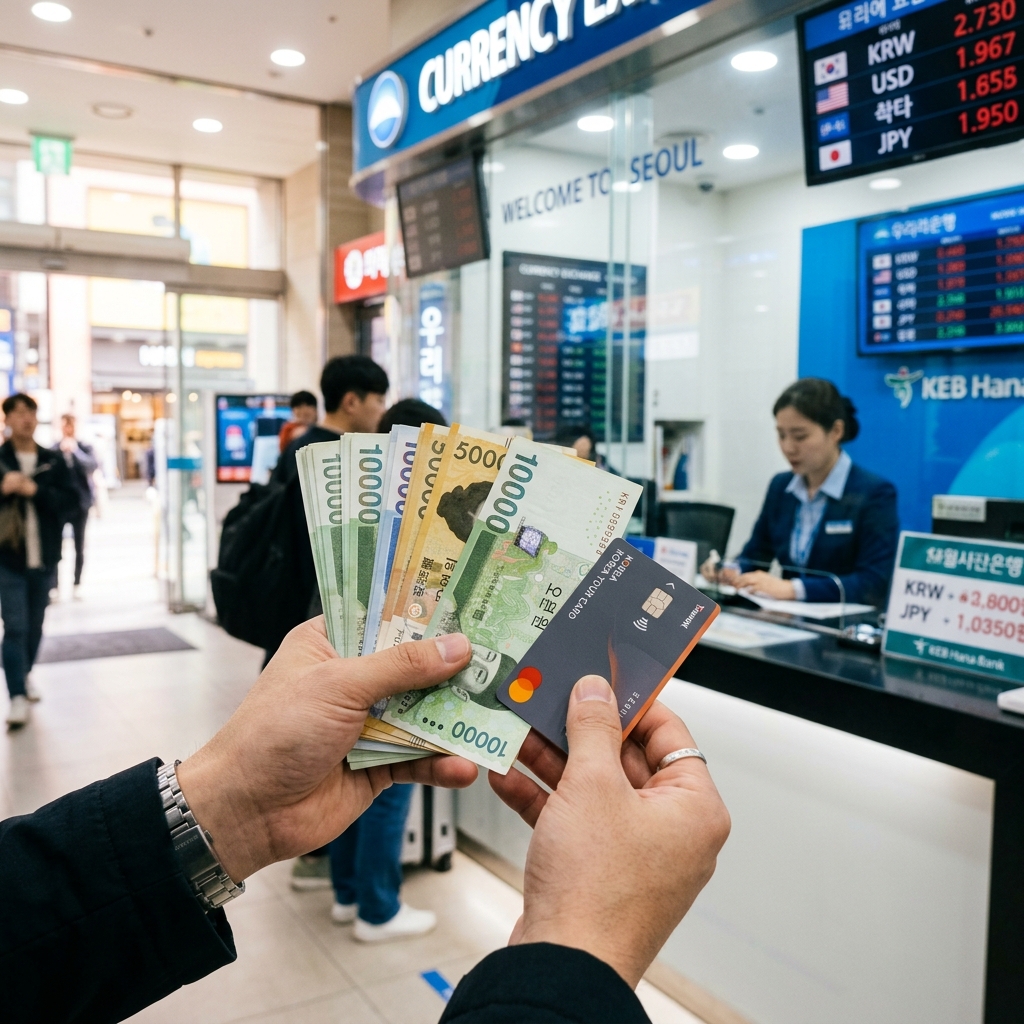
"Formulating an accurate financial plan before touching down at Incheon International Airport prevents unnecessary transaction losses. Many traditional travel guides recommend carrying large volumes of physical paper bills. However, official commercial logs from the Bank of Korea indicate that the nation operates on a highly advanced cashless retail grid. Global card networks function reliably across nearly 99% of established merchants, including corporate hotels, standard convenience stores, casual diners, and major retail centers. Understanding where paper currency remains mandatory allows you to optimize your initial currency exchange volume."
The Cashless Retail Architecture of South Korea
Formulating an accurate financial plan before touching down at Incheon International Airport prevents unnecessary transaction losses. Many traditional travel guides recommend carrying large volumes of physical paper bills. However, official commercial logs from the Bank of Korea indicate that the nation operates on a highly advanced cashless retail grid.
Global card networks function reliably across nearly 99% of established merchants, including corporate hotels, standard convenience stores, casual diners, and major retail centers. Understanding where paper currency remains mandatory allows you to optimize your initial currency exchange volume, saving you 30 minutes of wait time and station queue delays.
Scenarios Requiring Mandatory Physical Cash Banknotes
Relying entirely on digital payment card networks will introduce immediate travel bottlenecks upon arrival. Local municipal infrastructure isolates specific transactions to a strict closed-loop cash protocol.
Public Transit Card Top-Up Restraints
The primary transportation networks—including city subways and public buses—rely on localized chip cards like T-Money or WOWPASS. According to municipal transit regulations, automated station kiosks are legally blocked from processing international credit cards. You must feed physical South Korean Won banknotes into the machine slots to load transit fare value onto the chips.
Traditional Street Markets and Outdoor Stalls
While major established shops process cards seamlessly, independent outdoor food stalls operating in historical districts or traditional retail markets prefer physical cash banknotes. Carrying a small pool of local currency bills is required to purchase traditional street food snacks or minor handmade souvenirs.
Analyzing Airport Spreads vs City Center Private Modules
When determining where to convert your home currency into South Korean Won, tracking the transaction spread margins preserves your travel capital.
The High Overhead Fees of Airport Bank Counters
Banking kiosks operating within the airport arrival halls experience significant administrative overhead. This structural layout forces them to enforce wider exchange spreads, resulting in a measurable loss of net value for walk-up international tourists who convert their entire budget at the gate.
Competitive Margins in Myeongdong Exchange Clusters
For your primary cash requirements, carrying your home currency bills directly into the city center is a practical choice. Specialized private currency exchange modules located within the Myeongdong commerce lanes operate with highly competitive wholesale margins, providing the tightest conversion spreads in the capital.
Recommended Initial Currency Exchange Volumetric Targets
Structuring your initial cash reserve keeps your travel wallet efficient without exposing excess funds to repetitive conversion fees.
Based on traveler log parameters, a practical allocation for an average international visitor is exactly KRW 50,000 (approx. $37.00) to KRW 100,000 (approx. $74.00) in cash per person before or immediately upon arrival. This specific capital pool is computed solely to cover your initial airport rail tickets, transit card activations, and immediate street-level incidentals, leaving all large-scale expenditures to be processed via standard credit networks.
Frequently Asked Questions (FAQ)
Q1: Can I use an international debit card at any local ATM to withdraw cash?
Yes, provided you locate an automated teller machine displaying a prominent "Global ATM" emblem. Standard domestic-only units will reject foreign mainboards. Ensure you check your home bank's international transaction fee penalties before extracting funds.
Q2: What is the most practical banknote denomination to carry in Seoul?
The KRW 10,000 (approx. $7.40) bill is the most highly functional denomination for daily transactions. While the KRW 50,000 (approx. $37.00) banknote is widely accepted, utilizing it to pay for small convenience items under KRW 3,000 (approx. $2.22) can occasionally exhaust the cashier's physical change reserves.
Q3: Are coin currencies still used frequently in the subway stations?
Automated ticket machines handle coins for single-use paper tickets, but modern public transit card top-up terminals focus primarily on processing paper banknotes starting from KRW 1,000 (approx. $0.74) increments.
Q4: Do taxi drivers accept credit cards for short-distance trips?
Yes. Standard metered city taxis are legally required to house functional electronic payment terminals linked to global card networks, allowing you to bypass cash needs for a 1-hour airport transfer. You only require cash if the vehicle's terminal encounters an unexpected cellular network drop.
Q5: Can I exchange leftover Korean Won back into my home currency easily?
Yes. Major commercial bank branches and city center private exchange booths process reverse conversions. However, because you lose value on both sides of the exchange spread, minimizing your initial cash procurement prevents this double transaction loss.
Official Express Transit Passes & Hotel Rates:
Bypass ticket line delays. Pre-book your mobile express train tickets or search premium central transit hotels. Access official partner ticket booking options in the comment section below.
Book discount express train tickets and search live hotel room rates in the Comment Section below (Official Partner Integration)


🌐 Seoul Transit & Hotel Resources
ReplyDelete☑️ Pre-book Airport Train Tickets (Klook): klook.com/?aid=117966
☑️ Browse Top Seoul Hotel Deals (Agoda): agoda.com/partners/partnerlanding.aspx?cid=1966640