7 Tourist Mistakes That Waste Money in Korea
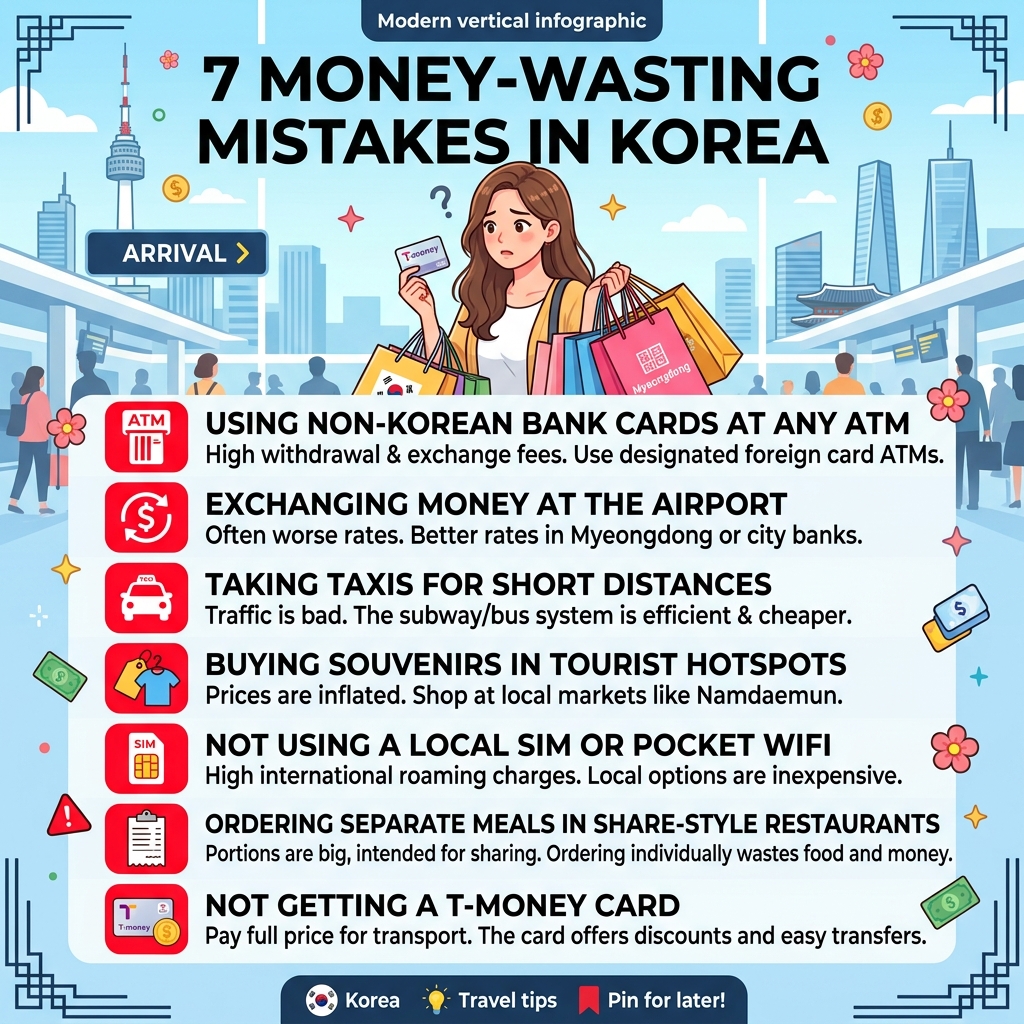
"Navigating the retail and transit systems of South Korea is highly efficient, yet first-time international visitors frequently encounter hidden systemic overheads. Financial loss during a holiday rarely stems from baseline consumer pricing. Instead, it accumulates through minor procedural errors made at point-of-sale registers, transit gates, and currency exchange kiosks. Analyzing official municipal transaction frameworks reveals seven primary traps that systematically drain international travel funds."
Introduction to Tourist Financial Logistics
Navigating the retail and transit systems of South Korea is highly efficient, yet first-time international visitors frequently encounter hidden systemic overheads. Financial loss during a holiday rarely stems from baseline consumer pricing. Instead, it accumulates through minor procedural errors made at point-of-sale registers, transit gates, and currency exchange kiosks.
Analyzing official municipal transaction frameworks reveals seven primary traps that systematically drain international travel funds.
1. High-Spread Airport Bank Conversions
The earliest financial error occurs immediately after clearing customs in the arrivals hall. Walk-up banking counters operating within airport terminals carry high operational overhead fees. These facilities enforce wider exchange spreads, often charging a premium markup of 6% to 9% compared to wholesale market indices. Converting your entire travel capital at the airport terminal results in an immediate reduction of net purchasing power.
2. The Point-of-Sale Dynamic Currency Conversion (DCC) Trap
When paying with an international credit card, modern merchant checkout terminals recognize foreign card networks instantly. The system screen often prompts you to choose between paying in your home country currency or South Korean Won (KRW).
Selecting your home currency triggers Dynamic Currency Conversion (DCC). This protocol allows the local retail bank to apply an arbitrary conversion fee of 4% to 8% to the transaction, bypassing your home bank's standard foreign transaction protections.
3. Repeated Purchases of Single-Journey Paper Transit Tickets
Relying on single-use yellow paper tickets for every individual subway trip introduces constant financial and temporal friction. Every single-journey transaction appends a mandatory KRW 500 card deposit fee to the fare. While this deposit can be recovered via physical cash return machines at your destination station, the process drains valuable travel time and completely blocks you from accessing the integrated metropolitan transfer discount network.
4. Attempting Credit Card Taps Directly at Metro Turnstiles
A common point of confusion for international arrivals is assuming that standard global contactless credit cards or mobile wallets can tap directly through public subway gates. South Korean transit infrastructure relies on a separate closed-loop network. Attempting to force an unlinked foreign card through the gates causes terminal errors, forcing you to step out of line and purchase independent local transit chips under time pressure.
5. Hailing Unofficial Private Vehicles Near High-Volume Transport Exits
Immediately outside major rail intersections and stadium event boundaries, unauthorized private drivers frequently solicit arriving tourists directly. These drivers bypass the official metered taxi queues and offer flat-rate pricing structures that routinely run double or triple the standard government-regulated taxi tariff. Always utilize authorized taxi dispatch lanes or localized ride-hailing applications to guarantee standard metered rates.
6. Omitting the Exit Tap on Municipal Surface Buses
When utilizing the public bus network, passengers must tap their transit cards on the digital terminal scanners both when boarding and when exiting the vehicle. Failing to execute the final exit tap before stepping off the bus triggers an automated maximum distance penalty fare on your next trip. It also completely breaks the 30-minute free transfer matrix link, charging you a full baseline fare for your subsequent connecting ride.
7. Blind Activation of Unlimited Tourist Passes Without Volume Audits
The availability of short-term unlimited tourist transit passes creates a false sense of automatic savings. If your travel itinerary concentrates heavily within a single walkable district like Myeongdong or Hongdae, you will likely ride the transit lines fewer than three times a day. Under low-frequency usage, the upfront plastic procurement fees and fixed package costs result in a net loss compared to simple pay-as-you-go card models.
Frequently Asked Questions (FAQ)
Q1: Is tipping legally required or expected at high-end restaurants in Seoul?
No. Tipping is not part of the local service culture in South Korea. Attempting to leave a cash tip at a standard dining establishment can cause confusion, as service charges are legally integrated into the baseline price displayed on the menu.
Q2: What is the most cost-effective location to exchange physical paper cash?
The private currency exchange modules located within the Myeongdong commercial district consistently provide the narrowest spread margins in the capital city, operating close to the live wholesale market exchange indices.
Q3: Do street food stalls in traditional markets accept credit cards?
The vast majority of modern brick-and-mortar retail shops handle cards perfectly. However, independent outdoor food stalls operating inside traditional markets heavily prefer physical cash Won banknotes or local bank transfers.
Q4: Can I load money onto a T-Money transit card using a digital payment app?
Standard automated subway ticket machines located inside station lobbies are legally locked into processing physical cash banknotes only. You cannot use an international card to reload transit value at a station kiosk.
Q5: What should I do if a taxi driver refuses to activate the meter?
Step out of the vehicle immediately before the journey begins. If the vehicle is already in motion, locate the official tourist complaint QR code or registration number displayed on the dashboard and report the license plate to the municipal authority.
Official Express Transit Passes & Hotel Rates:
Bypass ticket line delays. Pre-book your mobile express train tickets or search premium central transit hotels. Access official partner ticket booking options in the comment section below.
Book discount express train tickets and search live hotel room rates in the Comment Section below (Official Partner Integration)


Comments
Post a Comment