NAMANE Card vs WOWPASS vs Climate Card: The Ultimate Cashless
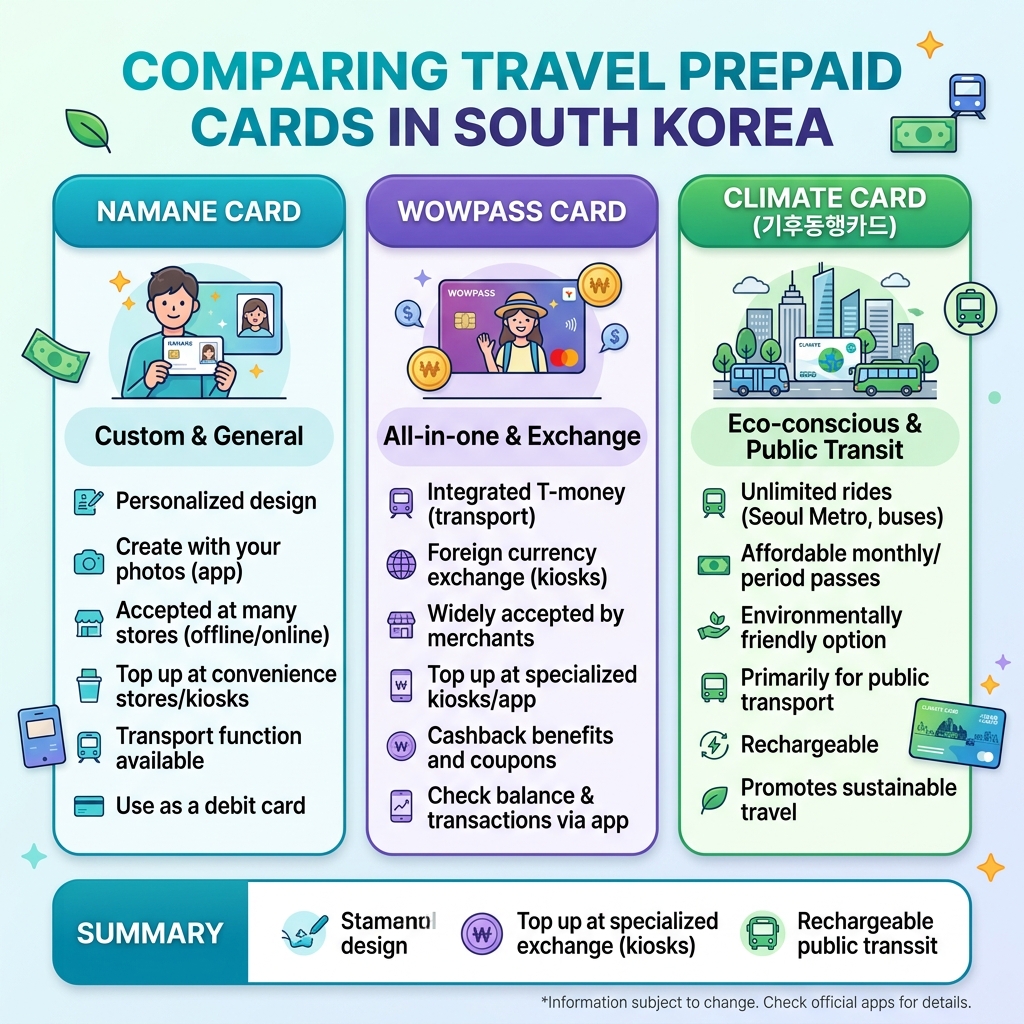
Landing in Seoul expecting to utilize your standard US credit cards for every micro-transaction introduces immediate operational friction. While South Korea is practically a cashless society, its digital payment infrastructure runs on isolated domestic networks.
Foreign travelers frequently face sudden credit card rejection errors at self-service kiosks, automated ordering screens, and subway ticketing docks. To bypass these transaction blocks, you must deploy a localized prepaid tourist pass. Choosing between the NAMANE Card, WOWPASS, and the Climate Card requires analyzing their card issuance fees, top-up channels, and transport integrations.
Prepaid Tourist Card Performance Matrix
Based on live banking fee structures and metropolitan transit operational logs, here is the baseline performance matrix for the three dominant localized card assets.
| Evaluation Metric | WOWPASS Card | NAMANE Card | Climate Card (Prepaid) |
|---|---|---|---|
| Upfront Issuance Fee | 5,000 KRW (~$3.70 USD) | 7,000 KRW (~$5.15 USD) | 3,000 KRW (~$2.20 USD) for physical card |
| Primary Top-Up Method | Foreign physical cash bills via specialized orange kiosks | Mobile app via international credit cards or cash | Physical cash bills only at subway station terminals |
| Retail Shopping Utility | High (Accepted at any standard IC chip terminal) | High (Features split balances for retail and transit) | Zero (Strictly restricted to metropolitan transit) |
| Transit Network Integration | Built-in T-Money circuit (Requires separate cash to load) | Custom transit ledger (Loadable directly via mobile app) | Unlimited city bus and subway rides for a flat multi-day fee |
The Kiosk Error Trap: The T-Money Cash Constraint
The single largest friction point for US travelers utilizing WOWPASS or standard credit cards happens at the subway turnstile. The WOWPASS features a built-in T-Money transit chip. However, due to strict local financial zoning rules, the retail balance and the transit balance operate on entirely separate circuits.
When you top up your WOWPASS with US dollars at an orange kiosk, that money goes strictly into your retail shopping ledger. If you try to tap into a subway station gate without loading the transport chip independently, the turnstile will flash an error code. To load the transit side of the WOWPASS, you must physically withdraw paper Korean Won bills, march to a standard subway station terminal machine, and feed the physical cash into the slot.
The NAMANE Advantage: Bypassing the Cash Requirement
The NAMANE Card resolves this cash-handling friction by allowing you to manage your entire transaction architecture inside a smartphone app.
Mobile Top-Up: You can link your US Visa or Mastercard directly to the NAMANE application to load your balance digitally, eliminating the need to search for physical exchange kiosks on the street.
Balance Shifting: The app features a functional interface where you can instantly slide funds between your retail shopping ledger and your transit ledger in less than a single minute with zero service fees.
The Cost: The trade-off is a higher initial card customization fee (7,000 KRW) and a 6% processing fee on international credit card top-ups within the mobile app environment.
The Climate Card: Pure Transit Optimization
The Climate Card eliminates distance-based fare calculations entirely, offering unlimited subway and bus rides inside the official Seoul boundary for a low flat rate (e.g., 5,000 KRW for a 1-day pass).
The critical drawback is its total lack of commercial shopping utility. You cannot use it to purchase coffee at convenience hubs or pay for meals at night markets. Furthermore, physical cards are frequently sold out at central tourist stations, requiring travelers to search multiple convenience stalls just to secure the plastic casing.
Final Selection Blueprint
For Maximum Shopping Convenience: Purchase a WOWPASS. It offers the tightest currency exchange spreads when feeding foreign paper cash into the kiosks and acts as a standard local debit card.
For Zero-Cash Digital Management: Choose a NAMANE Card. It keeps your entire payment pipeline inside your mobile application, completely removing paper currency from your itinerary.
For Intense Sightseeing Routes: Layer a physical Climate Card on top of your standard payment methods to eliminate transportation fare friction completely inside the city core.
To plan your initial route from the arrival gate to the closest card printing terminal without routing errors, checking out direct local mapping layouts is highly recommended.
📍 Seoul Prepaid Card Fee Guidelines: Vetted via official regulatory data sheets from the Seoul Metropolitan Government.
🏨 Vetted Central Accommodations: Secure pre-verified, highly connected hotel bases flanking major tourist card kiosks across Seoul via Agoda (Node 1 Tracking Code: 1962409).
⚡ Verified Cashless Support: View in the Comment Section below
Essential travel gear recommended for optimal safety and comfort during your journeys.Travel Essentials
Verified Gear
RFID Blocking Travel Neck Wallet
★ 4.9
📍 Data sourced from Korea Tourism Organization (TourAPI) & Seoul Metropolitan Government.
🏨 Secure Vetted Hotels via Agoda → Browse Verified Stays (Agoda)
🎫 Book AREX & Transit Passes via Klook → Get Discounted Passes (Klook)